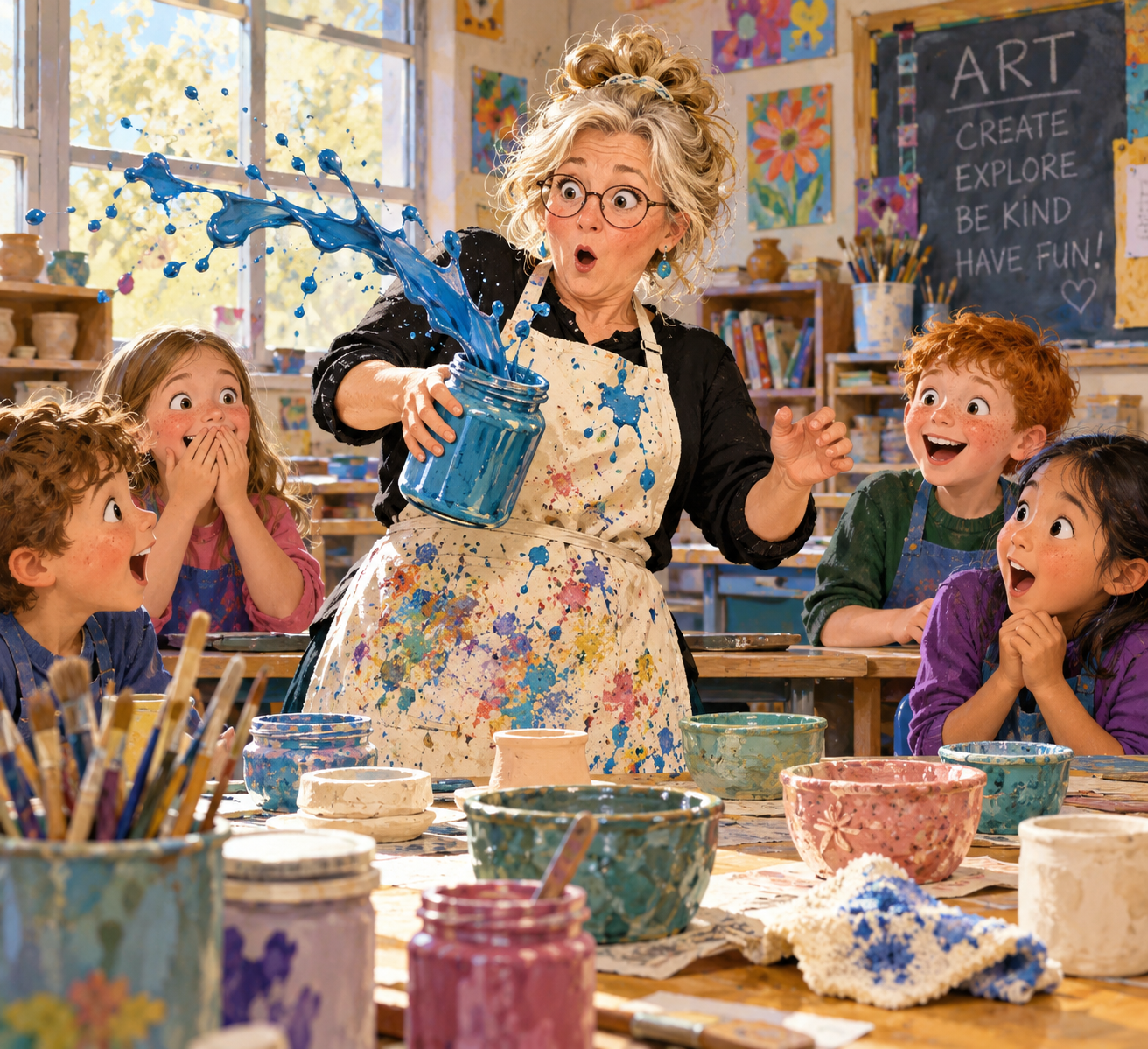
Glazing day was one of the most exciting parts of working with clay. After all the rolling, building, and waiting, students finally got to choose colors. I always gathered them around the demonstration table to show them how it worked.
The first thing they had to understand is that glaze is not paint. The color in the jar often looks nothing like the finished piece, so I prepared samples ahead of time showing what each glaze looked like once it was fired.
Then came the application. One thin coat isn’t enough. You apply a coat, let it dry, apply a second coat, let it dry, and then add a final coat. The other rule was just as important: no glaze on the bottom of the piece. Glaze melts in the kiln and glues the piece to the shelf, so the bottoms had to be checked and wiped clean with a damp sponge.
That day I had jars of glaze lined up on the table, ready to go. I picked one up and gave it a good shake, not knowing the lid wasn’t on tight. It flew off, and glaze went everywhere!
The students screamed and laughed, and then they all stopped and looked at me as if to say, “Oh no.” All I could do was laugh along with them while I looked around to make sure no one was covered. Somehow, it missed everyone’s clothes and, even better, their faces. I was wearing an apron, as I always did, which turned out to be a good habit.
I don’t remember whether I used that jar or picked another one, but from then on I never shook a jar of glaze without checking the lid first. I also never let the students open the jars. That was my job, just in case.



Leave a Reply